Glorious weather this autumn, so nice to still be enjoying afternoon walks in the sunshine and not needing to wrap up warm yet. Chilly overnight, maybe 8 degrees or so, but out in the sun in a t-shirt during the day.
Just past the cemetery at Yegen, there is a new seating area...
The view from here looking towards Sierra Gador....Not a cloud in the sky!
Poplars down in the valley....
Nearer home is an old era, a threshing circle, catching the afternoon sun on the stones.
And on the edge of the era is an old piece of machinery. Not sure what it is but possibly an almond husker. It's got a drum where I can imagine the almonds being put in and as it spins the husks come off, but maybe something to do with olives.... suggestions anyone??
Another afternoon, another walk, this time down to the river below Golco. Both walks are about 2km / 4km return, but whereas Yegen is 300m or so higher than us, with a nice gentle return trip, the walk to the river is mostly down but then a climb back home.
Friday, 11 November 2016
Saturday, 22 October 2016
A birthday break in Almeria.
We have just spent a couple of days in Almería for my birthday. It's not a place that we have stayed in before, it's just somewhere that we've been through and have thought that it would be good to explore as it has a rich history. The best description I can give is that it's like a small version of Granada, what with the Cathedral and the Alcazaba, and the old quarter too.
So this is going to be mostly pictures......
Not our Montenegro but a hill/mountain in Almeria higher than us. We are at 890 metres, the other Montenegro is 1710 metres up. Quite a climb!!
And then inside the Cathedral. Obviously these few pictures don't do justice to the inside - there are carvings both wood and marble, it's gilded, there are wonderful paintings too, this is just a small sample.
And for the foodies......
Of course there was more food and also a drink or two - but sometimes food comes before photos!!
A wonderful couple of days but now back to a normal healthy diet - less food and more exercise!
So this is going to be mostly pictures......
| Hotel Catedral, Plaza de la Catedral, where we stayed. |
| Palacio Episcopál, Plaza de la Catedral |
| The very fortress-like Cathedral as seen from the hotel roof terrace. |
| La Alcazaba as seen from our hotel roof terrace. |
| Bar Montenegro, almost next to our hotel |
| and another one! |
| Basilica de Nuestra Señora del Mar |
| Iglesia de San Pedro |
| The School of Art |
| The Theatre |
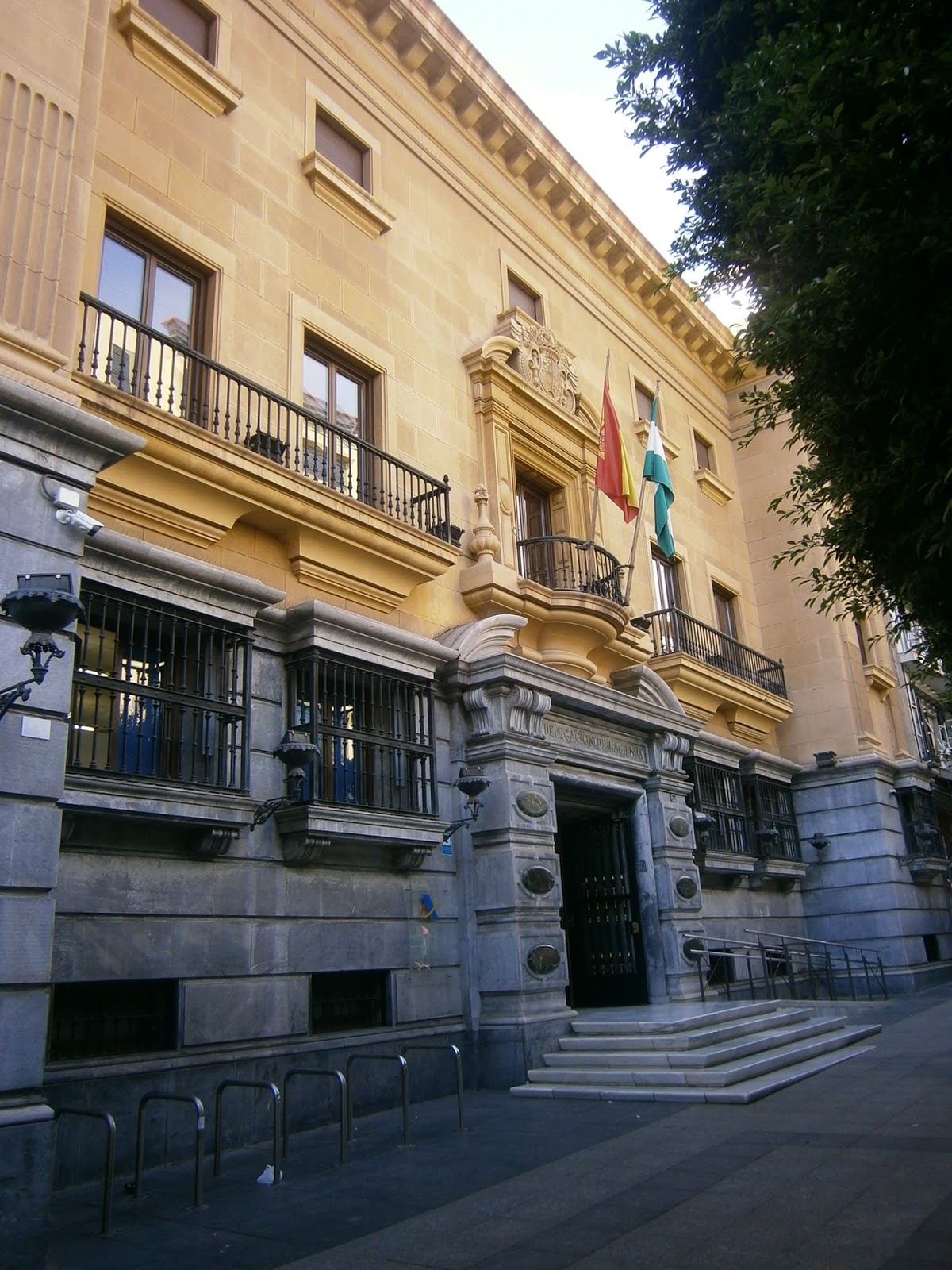
| La Hacienda - tax office. |
| Shops downstairs, carved windows and arches above..... |
| both buildings at Puerta de Purchena. |
And then inside the Cathedral. Obviously these few pictures don't do justice to the inside - there are carvings both wood and marble, it's gilded, there are wonderful paintings too, this is just a small sample.
And for the foodies......
| Lunch at La Lupe. Quesadillo + chilli @ 3 euros each. Plus a beer each. |
| La Lupe again for dinner, 1 x house salad with grilled chicken and jalapeños @9.50 |
| Secreto a la brasa - very tender beef done on the griddle 2 @ 14 euros. |
| Another day, more food! At Casco Antiguo for lunch, a Thai salad 1/2 size starter. |
| Timbale of monkfish and prawns for my main course. |
| Restaurant Casco Antiguo house burger. And did he struggle with this! |
A wonderful couple of days but now back to a normal healthy diet - less food and more exercise!
Saturday, 15 October 2016
Autumn update
Doesn't time fly! Now we are into autumn colours, the leaves are turning into different shades of yellow and gold and rusty brown shades. But most days the weather is still warm and although I haven't swum since the end of September it's still warm enough for visitors to enjoy.
Our family from Paris has been visiting recently, with the addition of a 3 month old now, on their first day here, we went to La Videña restaurant in Ugijar where a drink with a tapa is 2 euros, it makes a nice leisurely lunch and not too filling.
Samuel is enjoying looking around - Elliott is keeping an eye on him.
And so on to Cadiar for the Feria, we only went in on the Friday for Elliott to enjoy the ball park and the bouncy castle while we had wine at the fuente and pinchos at the food stalls.
A few days later we went down to Salobeña for a day on the beach plus lunch and dinner and an overnight stay at the Hotel Avenida Tropical, where we have been quite a few times and never been disappointed. This time we had a lovely courtyard outside our room, ideal late in the evening for a glass of wine.
First to the beach...
Busy isn't it!! Apparently the water was warm enough, Mat and Elliott were both in splashing around.
Then for lunch at Chiringuito Casa Emilio - again somewhere we have eaten more than a few times over the past 13 years and always enjoyed.
Much later that day we all stopped for drinks and tapas before going out for dinner.
And then last of all we went for dinner. But by then I'd forgotten to take pictures except of the amazing plate of food of mine. Spicy prawns. Sounds so simple but just look at the carrot and cucumber decoration. Fresh prawns, crunchy veg, nothing orange and artificial tasting about the sauce - wonderful. As was everyone else's food but I was too busy enjoying mine for photos.
Our family from Paris has been visiting recently, with the addition of a 3 month old now, on their first day here, we went to La Videña restaurant in Ugijar where a drink with a tapa is 2 euros, it makes a nice leisurely lunch and not too filling.
| fajitas mexicano y tomate aliñado |
| Bacon con queso y Sherigan de pate |
And so on to Cadiar for the Feria, we only went in on the Friday for Elliott to enjoy the ball park and the bouncy castle while we had wine at the fuente and pinchos at the food stalls.
A few days later we went down to Salobeña for a day on the beach plus lunch and dinner and an overnight stay at the Hotel Avenida Tropical, where we have been quite a few times and never been disappointed. This time we had a lovely courtyard outside our room, ideal late in the evening for a glass of wine.
First to the beach...
Busy isn't it!! Apparently the water was warm enough, Mat and Elliott were both in splashing around.
Then for lunch at Chiringuito Casa Emilio - again somewhere we have eaten more than a few times over the past 13 years and always enjoyed.
| Obvious no? the view from our table to the sea. |
| My house salad starter |
| John's seafood soup |
| House white wine |
| Mat and Airi's paella |
| John's rape (monkfish) grilled |
| My rape en salsa (sauce of tomato and almonds) |
Much later that day we all stopped for drinks and tapas before going out for dinner.
| John's G+T plus my wine |
| Our tapas |
Saturday, 30 July 2016
Paella Valenciana
Late on Wednesday evening there was a knock on the gate and a ¡hola! from Miguel and Cristina, family of neighbours of ours, we are making paella tomorrow for lunch so please come, and please be hungry as it will be big! Come about 1.30, so that is a Spanish 2pm, lunch won't be much later than that...... anyway we wandered up at about 1.30 for a drink and Miguel was cooking the chicken and rabbit in the paellera, a circular shallow pan with 2 handles and traditionally cooked over an open fire. But when it's 33 degrees outside in the shade, he was cooking indoors, but with the door open and the sun shining in....... it was 33 inside too!
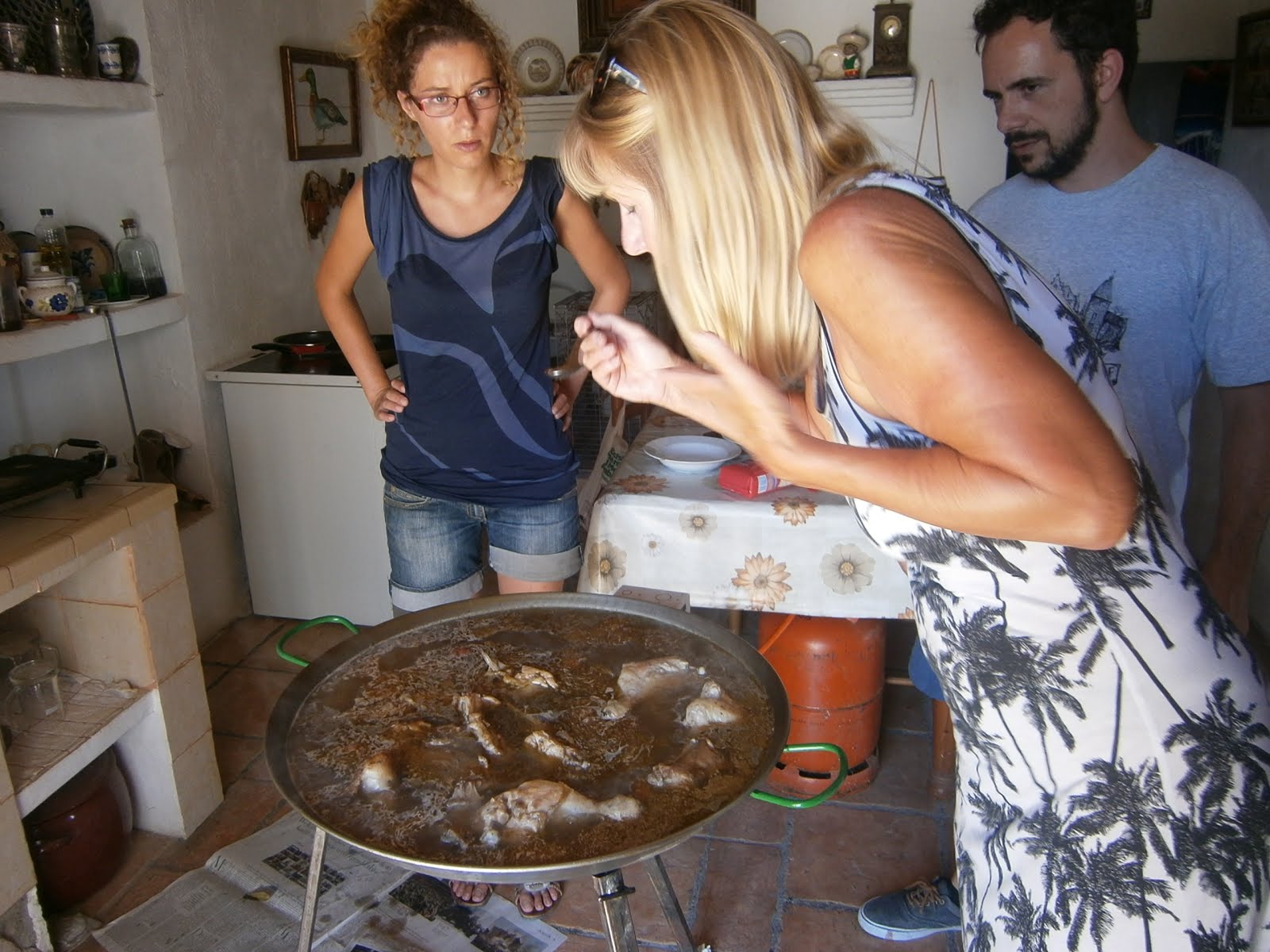
When the meat was cooked and the vegetables sauteed, the water and saffron were added. The next bit was crucial apparently. They said that the guests - me and John - had to taste the broth and when that was just right they could add the rice. If the end result was not perfect, the fault was ours not the chefs! As John was on camera duty, the tasting was down to me.


All done! They cooked a 10 person sized paellera and although there were only 8 of us, there wasn't much left.
And if you are wondering, the cooking took longer than expected so we didn't eat till 3.30 - late I think even for the Spanish, but Mariano (Miguel's father) put out plates of sliced cheese to keep us all going along with the wine from Paco and Antonio.
I read up about different paellas tonight, Miguel left his to cook till all the stock was absorbed and the rice was crispy on the bottom....
After cooking paella, there is usually a layer of toasted rice at the bottom of the pan, called socarrat in Spain. This is considered a delicacy among Spaniards and is essential to a good paella. The toasted rice develops on its own if the paella is cooked over a burner or open fire. If cooked in an oven, however, it will not. To correct this, place the paellera over a high flame while listening to the rice toast at the bottom of the pan. Once the aroma of toasted rice wafts upwards, it is removed from the heat. The paella must then sit for about five minutes (most recipes recommend the paella be covered with a tea-towel at this point) to absorb the remaining broth.
Information and the recipe for a Valencian Paella is here...
(From wikipedia)
Living standards rose with the sociological changes of the late 19th century in Spain, giving rise to gatherings and outings in the countryside. This led to a change in paella's ingredients as well, using instead rabbit, chicken, duck and sometimes snails. This dish became so popular that in 1840 a local Spanish newspaper first used the word paella to refer to the recipe rather than the pan.[17]
The most widely used, complete ingredient list of this era was as follows: short-grain white rice, chicken, rabbit, snails (optional), duck (optional), butter beans, great northern beans, runner beans, artichoke (a substitute for runner beans in the winter), tomatoes, fresh rosemary, sweet paprika, saffron, garlic (optional), salt, olive oil and water.[17] Poorer Valencians, however, sometimes used nothing more than snails for meat. Valencians insist that only these ingredients should go into making modern Valencian paella.
No snails in ours thankfully, just rabbit from Paco and chicken from the butchers, rosemary from a bush next to the house, and wine from Mecina Bombaron and Montenegro, not many food miles in that big dish!
When the meat was cooked and the vegetables sauteed, the water and saffron were added. The next bit was crucial apparently. They said that the guests - me and John - had to taste the broth and when that was just right they could add the rice. If the end result was not perfect, the fault was ours not the chefs! As John was on camera duty, the tasting was down to me.
All done! They cooked a 10 person sized paellera and although there were only 8 of us, there wasn't much left.
And if you are wondering, the cooking took longer than expected so we didn't eat till 3.30 - late I think even for the Spanish, but Mariano (Miguel's father) put out plates of sliced cheese to keep us all going along with the wine from Paco and Antonio.
I read up about different paellas tonight, Miguel left his to cook till all the stock was absorbed and the rice was crispy on the bottom....
After cooking paella, there is usually a layer of toasted rice at the bottom of the pan, called socarrat in Spain. This is considered a delicacy among Spaniards and is essential to a good paella. The toasted rice develops on its own if the paella is cooked over a burner or open fire. If cooked in an oven, however, it will not. To correct this, place the paellera over a high flame while listening to the rice toast at the bottom of the pan. Once the aroma of toasted rice wafts upwards, it is removed from the heat. The paella must then sit for about five minutes (most recipes recommend the paella be covered with a tea-towel at this point) to absorb the remaining broth.
Information and the recipe for a Valencian Paella is here...
(From wikipedia)
Valencian paella
On special occasions, 18th century Valencians used calderos to cook rice in the open air of their orchards near lake Albufera. Water vole meat was one of the main ingredients of early paellas,[20] along with eel and butter beans. Novelist Vicente Blasco Ibáñez described the Valencian custom of eating water voles in Cañas y Barro (1902), a realistic novel about life among the fishermen and peasants near lake Albufera.[21]Living standards rose with the sociological changes of the late 19th century in Spain, giving rise to gatherings and outings in the countryside. This led to a change in paella's ingredients as well, using instead rabbit, chicken, duck and sometimes snails. This dish became so popular that in 1840 a local Spanish newspaper first used the word paella to refer to the recipe rather than the pan.[17]
The most widely used, complete ingredient list of this era was as follows: short-grain white rice, chicken, rabbit, snails (optional), duck (optional), butter beans, great northern beans, runner beans, artichoke (a substitute for runner beans in the winter), tomatoes, fresh rosemary, sweet paprika, saffron, garlic (optional), salt, olive oil and water.[17] Poorer Valencians, however, sometimes used nothing more than snails for meat. Valencians insist that only these ingredients should go into making modern Valencian paella.
- Heat oil in a paella.
- Sauté meat after seasoning with salt.
- Add green vegetables and sauté until soft.
- Add garlic (optional), grated tomatoes, beans and sauté.
- Add paprika and sauté.
- Add water, saffron (and/or food coloring), snails (optional) and rosemary.
- Boil to make broth and allow it to reduce by half.
- Remove the rosemary once flavour has infused or it starts to fall apart.
- Add rice and simmer until rice is cooked.
- Garnish with more fresh rosemary.
No snails in ours thankfully, just rabbit from Paco and chicken from the butchers, rosemary from a bush next to the house, and wine from Mecina Bombaron and Montenegro, not many food miles in that big dish!
Subscribe to:
Posts (Atom)