No, don't get worried, it's not an addition for us or to the dog kennel but a new addition to John's " webbery" for want of a better word.
http://www.las-alpujarras.net/ gets lots of traffic and some goes from here to there and vice versa.
Now there is another site, eventually much bigger and covering all of Andalucia's towns and villages. It can be found at PueblosAndalucia.com
As you browse, you will see links to airlines and hotels - so far - and if you book via this site, we shall earn a little bit. It doesn't have to be a booking within Spain, anywhere will do!
Saturday, 10 July 2010

Thursday, 8 July 2010
Defining Las Alpujarras
| When I set up the Alpujarras page some years ago, I tried to define what was (or were) La(s) Alpujarra(s). Since then, it has sat at the bottom of the homepage - as a footnote. I recently joined the Costa Living Forum and it made made me go back and look at it again. The "Consejería de Turismo y Deporte de la Junta de Andalucía" (roughly the Sport & Tourism Office) considers there to be two Alpujarras: La Alpujarra Almeriense and La Alpujarra Granadina. So there are two of them - one now in Granada province and one in Almeria Province (at least by this interpretation). It is probably close to being the Alpujarras that was given to the last Moorish Kings after they were expelled from Granada city (see history page). Though in those days it also extended down to the coast. | |
| And this is the way they appear on the current map of "comarcas" (roughly: shires or counties): |
 According to the Ministry of Agriculture, on the other hand, the Granadan Alpujarra is defined as "Las Alpujarras" and the Almerian Alpujarra as "Alto Andarax".
 Some people also consider the Alpujarras to extend, even to this day, across the Contraviesa mountain range and down to the coast. The recently published guide book entitled "The Alpujarra of Granada", for example, includes the municipalities of Albondon, Albunol, Gulachos, Lujar, Polopo, Rubite and Sorvilan. Produced by the "Mancomunidad de Municipios de la Alpujarra Granadina", this book is well worth the 15€ the Ayuntamiento make it available for.
From Wikipedia:
The current statutory entity that most closely resembles a comarca is the mancomunidad, a freely chosen, bottom-up association of municipalities intended as an instrument of socioeconomic development and coordination between municipal governments.and . . . .
Almost every Andalusian municipality outside of the capitals and major cities is a member of some such group. These groups consist of municipalities freely united by their economic interests and are often endowed with funds used for external dissemination of their identity.Perhaps the guide-book mentioned above may have got some funding from this source. Interestingly, looking at Almeria Province, I see that there is a " Mancomunidad del Medio-Alto Andarax y Bajo Nacimiento" so that would seem to make some of the east-enders no longer Alpujareños. They may have been taken over by the Andraxians! Just to further confuse the issue, there is also a Mancomunidad de Municipios de la Costa Tropica! They even have their own website at http://www.ctropical.org/ and have staked a claim on our very-own Murtas and Turon! So, in our southern regions we are in danger of being grabbed by the tropics. Here is a quote from the Alpujarra/Vallee de Lecrin leaflet published by the GRANADA tourist office:
The heart of the district is the Sierra de la Contraviesa, situated between Sierra Nevada and the Mediterranean coast. Vineyards abound on its hillsides, producing the excellent“Costa” wine, the ideal drink to accompany the area’s meat and cured ham products.It doesn't include anywhere in Almeria (of course!) but does include Albondón, Albuñol/la Rábita,Lujar, Polopos, Rubite and Sorvilán. Even the name Alpujarra doesn't really help much as its original meaning has been lost in history. There are some links at http://en.wikipedia.org/wiki/Alpujarras if you really want to follow it up but, in summary:
The name Alpujarras may derive from Arabic al Busherat meaning "the grass-land". Pedro Antonio de Alarcón travelled through the Alpujarras in the second half of the nineteenth century publishing in 1874 a book about the experience titled La Alpujarra. In this book he gives four possible origins for the name, based on the classical writer Luis del Mármol:" ('fortified'), following opinion of the Arabists Romey and Silvestre de Sacy. They based their conclusions on the work of the Arab historian Suar el-Kaicí.
- From Arabic "abuxarra" ('turbulent') referring to the tendency of its inhabitants to rebel against authority.
- From Arabic "abuxarra" ('the unvanquished') based on the work of the Arabist Miguel Lafuente Alcántara.
- From Arabic "albordjela
Thursday, 1 July 2010
Wine news
It's time for more wine news.....
last mulberries pressed today, giving another 40 litres
we used olive nets to catch the mulberries and yesterday, when the nets were washed and dried, I took them back up to the corral (old stables) where they are stored - along with a lot of other occasionally used things of ours - and saw the first black figs were ripe and dropping. So a change of plan for the afternoon, I picked 16 lbs (7 figs to a pound) and they are on their way to being wined (?)
It may seem that we are trying to make a lot, last year we made 100 litres or so, but over a year when there is also Christmas, New Year, fiestas, friends visiting, us going to friends with a bottle or two, you can see that you need far more than that. It's reckoned locally that you need 1.5 times the number of days ie 500 litres which sounds in the alcoholic range, but remember, it's not all drunk by us! And also when you visit someone, the choice of drink is wine, wine or wine, which means you aren't expected to have beer or G&T when they come here. We have Spanish friends who brew in 100 litre vats, in their bodegas, so what we produce in buckets in the kitchen is tiny by comparison. And the mulberry wine works out at 15c per litre. You can't do better than that.
Tuesday, 29 June 2010
Fruit and flowers
No more about mulberries for now, let's just say that even more dropped after the last post, we almost ran out of space and on Sunday we pressed most of the brews. So far, we have 90 litres clearing with another 30 or so to do soon.
The pear tree in the front garden has started to drop its fruit, much to the delight of Monty and Pip, as they both like to eat the pears. I'm not so impressed as we have flowers growing underneath. More importantly we also have some large sage plants and chives there which don't really need dogs trampling on them on their way to retrieve the fruit. So this evening I picked all the fruit from the tree, 18lbs of small pears, some ready to eat, some for keeping and the bruised/over ripe ones I'm going to try making cider with.
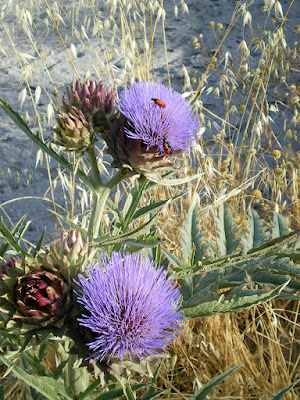 Another plant that grows here is the cardoon, it's most spectacular when in flower although it's supposed to be for eating - the leaves that is, not the flower - although I don't know anyone who does eat it. It looks tough, but maybe we should try it, possibly it'd be ok in soups or stews?
The pear tree in the front garden has started to drop its fruit, much to the delight of Monty and Pip, as they both like to eat the pears. I'm not so impressed as we have flowers growing underneath. More importantly we also have some large sage plants and chives there which don't really need dogs trampling on them on their way to retrieve the fruit. So this evening I picked all the fruit from the tree, 18lbs of small pears, some ready to eat, some for keeping and the bruised/over ripe ones I'm going to try making cider with.

Thursday, 24 June 2010
Any ideas?

Subscribe to:
Posts (Atom)
